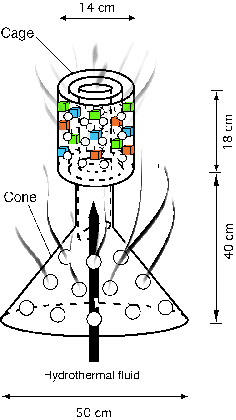
Illustration of ISCD
In-situ cultivation device (ISCD)1
An in-situ cultivation device was designed in order to collect facultative anaerobes that might be related to the eukaryotic origin from hydrohtermal fluids. We speculate that an archaeon and a bacterium involved in the genome fusion for the generation of a eukaryotic cell could be facultative anaerobes, since it should eventually engulf an aerobic alpha-proteobacterium that became mitochondria. The device consists of a cage that contains solid matrices such as dacite pumice and apatite, on which microorgamisms in the hydrothermal fluid may grow, and a cone that lowers the temperature of hydrothermal fluid that enters the cage by mixing with seawater.
Illustration of ISCD
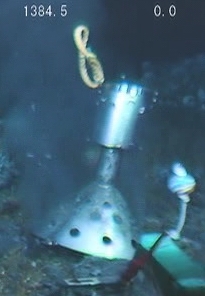
Deployment of ISCD. An ISCD was deployed at a hydrothermal vent (247℃) at Suiyo Seamount, Izu-Bonin Arc, western Pacific Ocean (28°34′N, 140°38′E), at a depth of 1384 m. Thermosipho globiformans was collected by the in-situ cultivation2.
References
1Kuwabara et al. (2006) Biosystem Studies 9, 218-227.
2Kuwabara et al. (2011) Int. J. Syst. Evol. Microbiol. 61, 1622-1627.